Monday, May 28, 2012

Progress in paradise ...


Golly, the sheep are threatening to overwhelm things. I may have to have a cull ... Though I have to say Palmer was never one to eek out his sheep when it came to a rural landscape.
And there's William Wordsworth, contemplating the moon in the finest nocturnal Romantic tradition of contemplating the moon, life, love and everything. And sheep, of course.


I almost had a disaster when I came in and discovered the big ginger, Princess Pushy, lying fast asleep in total feline abandon right across the board. (Actually, thinking about it, it would be a cat-astrophe, not a disaster). Anyway, to a large extent it was as so much was dislodged (and this despite my not yelling at her so as not to frighten her and scatter the lot), it took ages to restore order (thank goodness for my digital images).

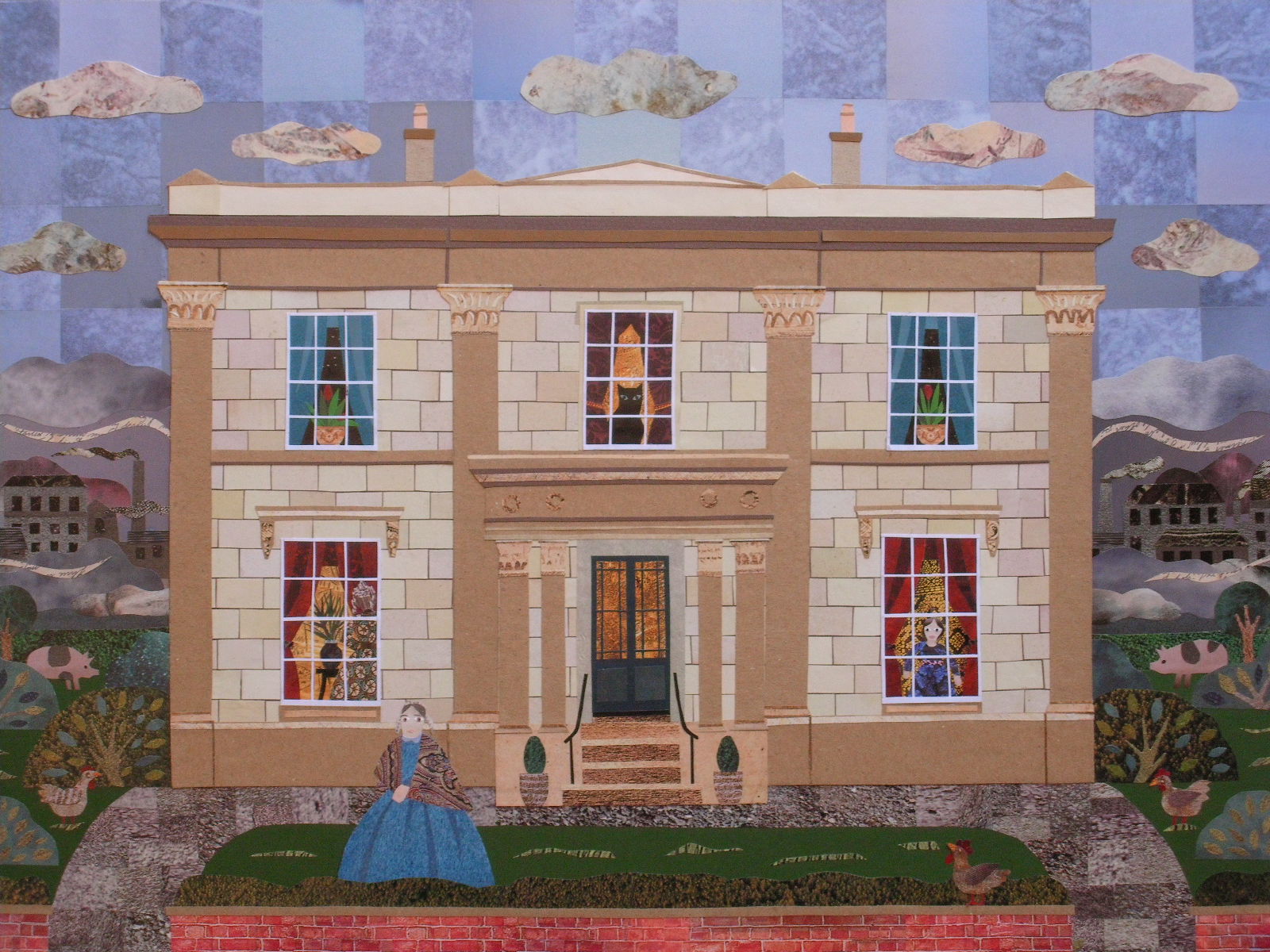
Am having trouble finding a nice large piece of slightly off-white for the house .... nothing in the scrap boxes is quite what I have in mind. And I really like to start the process of sticking the whole collage beginning with the house itself. 
Might have to resort to the stationer or art shop tomorrow .....

Saturday, May 26, 2012

An earthly paradise

That's how Dorothy Wordsworth described the grounds of Allan Bank, the rather grand house on the hill overlooking Grasmere Lake where in 1808 she, her brother William, his wife Mary, Mary's sister Sara and the three little Wordsworth children moved when they left the increasingly cramped conditions of Dove Cottage.


In addition there were two friends, fellow poets Samuel Taylor Coleridge and Thomas de Quincey, who also came to stay for protracted visits. Extraordinary characters, one of whom was in love with Sara.
It must have been quite an interesting and emotional household!

Ironically Allan Bank had been lambasted as a horrible blot on the landscape by Wordsworth as he had watched it being built, slap bang in the middle of his idyllic, beloved view from Dove Cottage a couple of years previously, a no-concessions white rectangle in the midst of lush green upland.

But as it turned out the Wordworth Allan Bank interlude was a brief one. The chimneys smoked horribly and William fell out with the landlord. After two years they left for pastures new though near.

The house is now a National Trust property, recently restored after fire destroyed much of the interior a few years ago.

The above is what I did yesterday. I haven't got very far as you see. Though I must admit it has moved on from the minimalist evening before:


As you see, it's all about moving the pieces around at the moment.

I've been looking at a lot of Samuel Palmer, Edward Calvert and British neo-Romantics lately and I think some of it has rubbed off. I enjoyed going through my boxes of cuttings to assemble a nice big swatch of nightime colours and reading some Wordsworth at bedtime to try and think my way into this imaginary landscape loosely based on some photos hunted down on the net (good old Google).

Saturday, May 19, 2012

All in the mind (and doodling book)

That post title is nothing to do with cod psychology, and everything to do with this:

To say nothing of this:
and this:

Meaning my life at the moment is dominated by ladders and housepaint. Very tiring. Not much time for proper creativity, just contemplating future projects:


Which are all Wordsworthian. I must say that over his long life, right from the very start, William lived in a succession of fabulous houses ... I will be spoilt for choice once I get back to the studio.

On another note I have to report two sad losses - two of my cats, Ghandi and Jess, dying within a few weeks of each other of unrelated causes. Well actually they were both getting on in years. So it was age related complications. 

Sadly missed by me, though how much by the remaining sprightlier four is debatable. Not much would be my guess.

Saturday, May 12, 2012

Moodier blues and the sky at night ....


The grey was a bit dead so after much faffing around I am adding some moody background. Underwater deep sea clippings (chiming with the writ in water epitaph) which double as mottled sky.
It's looking a bit Patrick Moore-ish now......

Thursday, May 10, 2012

An English poet by the Spanish Steps

Here it is.
The facade of the famous mansion in Rome, Piazza di Spagna 26, where, in a small apartment on the second floor, John Keats finally succumbed to what he called "the family disease" - consumption - on February 23, 1821.


At the time this area of Rome was a favourite for foreign (and particularly English) residents. During Keats and Severn's occupation their neighbours were (downstairs, on the first floor) one Thomas Gibson and his French valet. Upstairs was an Irishman, James O'Hara and an Italian military man, Giuseppe d'Alia.

The poet and his artist friend paid their Venetian landlady, Anna Angeletti, £5 a month in rent. 

By this time Keats had written all the poetry that place him among the greats. Literary exertions were beyond him, save for a few letters to friends in England. His last, indeed the last time he ever put pen to paper, was to his friend and former Hampstead housemate, Charles Brown.


He told him: "... I am afraid to encounter the proing and conning of any thing interesting to me in England. I have an habitual feeling of my real life having past, and that I am leading a posthumous existence."


I have tried to imbue this house (which is now the Keats-Shelley Museum) with something approaching the nostalgia which overwhelmed the dying Keats. Not sure how far I have succeeded. Though I must say I am quite pleased with the tension created by the rising pigeons and the falling roses, and the incorporation of a sonnet and the posthumous existence line into the building. 

Wednesday, April 25, 2012

A Roman work in progress ...

A departure from British houses, but a return to an old favourite.

I am currently re-reading Stanley Plumly's wonderful meandering poetic biography Posthumous Keats and couldn't help but sketch out an idea for a new house, the last lodgings of the poet in Rome and the place where he died.


It is still at the blocking in stage.

What caught my attention was the Naples yellow colouring of the walls that more or less matched the colour of the postcard of the manuscript of his sonnet Bright Star which was propped on a shelf in my studio. I photocopied it and got snipping. From that star came the idea of using a National Geographic photo of a galaxy for the interior of the flat where Keats and Severn lived for six months until Keats's death in February 1821.


Mmmmmm .... not sure where this is going yet but for what it's worth I will put it up if only to prove I am not slacking!

Wednesday, April 18, 2012

Jane Austen in Bath

4, Sydney Place
Jane Austen lived in three different houses during her Bath period. Her father had suddenly decided to retire and up sticks from the only home Jane had known for the first twenty-five years of her life and decamp to the fashionable spa of Bath.

We are so accustomed to seeing these beautiful honey-coloured buildings from an historical perspective that it's easy to forget that for Jane and her contemporaries they were new-builds.

Gracious and elegant on the outside, the interiors left much to be desired if we are to believe Jane. While still house-hunting she filled her sister in on their progress after a viewing of Green Park Buildings (which would be a subsequent Austen lodging and the place where her father eventually died):

"Our views of GP Buildings seem all at an end, the observation of the damps still remaining in the offices of an house which has been only vacated a week, with reports of discontented families and putrid fevers, has given the coup de grace..."

But number 4 Sydney Place (built in 1795) appears to have satisfied the Austen family and they moved in in the summer of 1801 and stayed until 1805.

One of its principle attractions was its proximity to one of Jane's favourite Bath haunts: Sydney Gardens, a park where (according to a contemporary source) "The hand of taste is visble in every direction." Indeed, number 4 overlooked (as it still does) the gardens, and the first floor drawing room commanded fine views over its sloping lawns and shady walks.

The hall and dining room were on the ground floor and a passage off led through to a pleasant garden at the back of the house.


The comings and goings of visitors to the gardens must have offered endless people-watching opportunities for the nosy Austen sisters...
And not just by day either.

"Upon gala nights the music, singing, cascades, transparencies, fireworks, and superb illuminations, render these gardens very similar to Vauxhall," wrote a contemporary chronicler.
Sounds divine.

Monday, April 9, 2012

On my studio doorstep this morning ...

Jess, looking even more surprised than I was.
 And I don't think the cat brought it!

4, Sydney Place (detail)
 Very quietly done as I was in, wrestling with the last bits of my Bath terrace house, but I may have been shouting at Radio 4 at the time (Mark Lawson should be taken out and shot for producing that tosh that passes for the 15 minute drama). Anyway, thank you to my daughter (in London) who arranged for a friend to make the special delivery and thank you again to my other one (also in London) for my new laptop. 

I just hope I can get to grips with the technical stuff and stop having to keep plugging in the old Amstradosaurus to upload photos on blog and other sites, various.

New laptop (with dinosaur keyboard in the background)

Saturday, March 31, 2012

Chawton Cottage - again


Drawn back to doing a view of Jane Austen's Hampshire cottage from the front, overlooking the busy road to Winchester. Okay, so I am capturing it at a not so busy time of day. Or not so busy day. 
Sunday then.
And it looks a bit churned up.
And there's a visitor calling.
Darn! Right in the middle of a beautifully turned sentence ...

Apparently Miss Austen, who didn't have A Room of Her Own (in the Virginia Woolf sense of a study - her father had one of those), would hide her work (i.e. whatever one of the series of classic works of English literature she was engaged on) under a blotter whenever visitors interrupted her flow of written words. A squeaky door she didn't allow to be oiled would give her sufficient warning to compose herself.


I hope the visitor in the picture is a welcome one.
With lots of the sort of gossip Miss Austen thrived on.

Wednesday, March 21, 2012

A bit of a ragbag ...

...  quite literally:


I've been trying to declutter some more but only succeed in shifting one pile of papers and scraps to a different drawer. Or even onto another pile. 

Anyway, one of my finds was an old scrapbook from my misspent youth. In fact I think it dates from when I was still at school. And in pride of place was a somewhat worse for wear page from the Sunday Times magazine, evidence of my early interest in all things primitive and naive as far as art goes. I feel it deserves an airing on the world wide web rather than languishing in my desk drawer.

So let me introduce you to the Royal Family, as never seen before and as depicted in life-size figures by an old man in Northumberland.

The caption reads:
"When Joe Bulmer was 80 he started a new hobby. Inspired by memories of a childhood visit to Madame Tussaud's, he began to build life-size figures of famous people from wood and clay - dressing them with a selection of clothes that he bought from local jumble sales. Thirteen years later he is still adding new personalities to his gallery of scarecrow art ..."

From left to right in the photo: Lord Snowdon, Princess Margaret, Princess Alexandra, the Queen Mother, the Queen, Prince Philip, the Duchess and Duke of Kent.

I love them and hope they still survive somewhere.

Monday, March 12, 2012

Simply black and white

I really DO love black ink and white paper!
And I also love the beautifully ever so subtly mottled shades of Canson paper. I get crazes on certain Canson colours. At one time it was the dusty blue one. Right now it's the greys and fawns.

These two collages were made from chopped up monoprints. The effect is a bit like a linoprint but with none of that medium's restrictions. Or (let's face it) time consumption. I like playing around with the pieces and moving them around. Which is one thing you can't do with a linocut.


I had Flora and the arrival of spring in the back of my mind as I assembled this image. Somehow it didn't seem finished until I put her in this paper mount with a primitive sort of frame. Gives it the folksy feel I was after.


Previously I made this other collaged monoprint inspired by my finishing off the Haworth paper cut - I obviously wasn't ready to leave the Brontës behind. I took a line from Emily as a point of departure: 
Lone, among the mountains cold ...
which is now the title.


I will be putting them in my Etsy shop when I next feel in an uploading kinda mood!
In the meantime I am going to clean up the ink trails left by one of the cats after he nonchalantly sauntered across the inked up glass sheet. Here are Freddo's paw marks on my desk. Nice monoprint! Don't even start me on the ones on my beige leather sofa .... 
Lucky I'm not a houseproud maruja!


Wednesday, March 7, 2012

Little Brontë foxes

Finished at last!


It's been a long time coming, mainly because of other stuff, as I mentioned before. Can't be doing with distracting background noise, literal or metaphorical, brings out the worst kind of procrastination in me.
Anyway, here it is, Haworth Parsonage in the snow (despite the fact that we have been experiencing summertime temperatures over here for the last few days).

The snowmen, which started out more prominent, have been relegated to watchers - watching the three sisters watching them from inside. So they retain their sinister, gothicky aspect even if somewhat watered down. The foxes were introduced as a splash of colour (I just knew that National Geographic portrait of an orange-haired kabuki actor would come in useful one day!) and movement. Three sisters ... three foxes ... mmmmm. Three snowmen if it comes to that. Obviously highly significant.
Or maybe not.

As is often the case with these house portraits it was a piece of the occupants' writings that settled me on the final image.
In this case a poem by Emily which starts:

The moon is full this winter night;
The stars are clear though few;
And every window glistens bright
With leaves of frozen dew ...

Well okay, lots of snowflakes rather than a few stars and lamplight rather than leaves of frozen dew.
Big full moon though.
 
Anyway, it is ready in time for my Christmas 2012 greeting card collection.
Method in my madness.

Saturday, February 25, 2012

Breaking the silence

Casa Amarilla, Gallinas Blancas

Well, it's been a long time ....
Mostly because I have been a bit preoccupied by stuff involving a good deal of queuing in official places just lately, then had my daughters staying for a fortnight and have been accustoming myself to new computer and new Windows ... that's my excuse anyway.

I'm not very happy with the way the snowy Brontes are going so they have taken a temporary back seat. In the meantime here are the two paintings (yes, I did say "paintings") I am showing next month at Delamore Arts in Devon at the British Naives exhibition.
Architecture again!

I took them into the framers today in an effort to be efficient and organized!
(Some hope).

Caribbean Church with Kling-Kling Birds

Saturday, February 11, 2012

Of snowmen, Brontës and tropical brass monkeys ...

A rough beginning ...
 No doodles this time ... because two sets of photographs featuring the snowmen of North and East London on the computer gave the impulse I needed to get cracking on an idea I had had for a while about "revisiting" Haworth Parsonage in winter. That and the cold weather currently assailing the allegedly semi-tropical island where I live. (I sit typing this in a thick woolly). 

A set of rather-worse-for-wear parkland snowmen popped up on one of my favourite blogs, Justine Picardie's (link down on the right somewhere) yesterday and just hours later my daughter sent some photos of a massive one with a huge spherical head and pebble teeth she had met down Clapton way.
I have always loved them. Spontaneous pieces of primitive art that spring up whenever a half-decent layer of snow is laid down. Strangely misshapen, grinning or grimacing, no two snowmen are ever the same.

Now I know the Brontës aren't exactly the sort of writers we would immediately associate with skylarking in the snow, but heck, even they were children once and must have taken time out at some point from eternally writing about Gondal in their teeny weeny interminable notebooks.

And even if they didn't - well I'm making them. 
My cut paper world, my say-so!

The Universal Snowman: A tropical version made by my daughter and nephew up on Tenerife's volcano a few years ago

Thursday, February 9, 2012

Summer Evening in the Austen Garden


Finished at long last! 

Jane Austen having an al fresco writing session on an idyllic summer's evening (hence the golden glow in the west!) surrounded by her flowers and her cats and serenaded by the birds. 

I am relieved to finish it because it seemed to become fiddlier by the minute. Miss Austen's minute eyebrows were the last straw - or should I say last pieces to be pasted down. The cats' eyeballs weren't exactly a piece of cake either!

Detail (what's she writing? A letter, a future classic or maybe just her shopping list?)
birdsong!
While I was searching for suitable pieces in magazines I came across a wonderful photo of an old fashioned coach and horses of the sort that thundered past the Austen cottage frontage and which Jane would have heard as she sat in her garden. I am very tempted to have a go at that scene but for the time being I'm tidying up the studio and my scrappings-littered table and going with the flow and seeing what surfaces in my doodle book ..
Also have to choose and photograph two paintings to send off for the great big British Naives show at Delamore House in May.

Right, time for a celebratory cup of tea and a chocolate biscuit I think


Tuesday, January 31, 2012

Al fresco with Miss Austen ...

You find me struggling with the garden, not an hour since I was hacking back the ivy (which is going bonkers - or should that be growing bonkers?) and potting up some pansies.


But my mind and inward eye was on Jane Austen's shrubs and borders which are what's on my ancient drawing board (a venerable and battered piece of solid wood that dates from my first week at art school more years ago than I care to remember - I may upload a photo of it some time).

As you see, I am still at the piecing and plotting stage after laying in a crazy quilt-style lawn.
Here's my original doodle:


Jane Austen's great-niece said:

"I remember the garden well, a very high thick hedge divided it from the Winchester road and around it was a pleasant shrubbery walk, with a rough bench or two where, no doubt, Mrs Austen and Cassandra and Jane spent many a summer afternoon ..."

Well, I have departed a bit from the rough benches I know though who knows they may yet supercede the more elegant wrought iron furniture.
Anyway, this is the current state of play.
Anything - or then again nothing - may happen in the next 24 hours.

Friday, January 20, 2012

Dickens in Doughty Street


Charles Dickens lived in this Georgian terrace in Holborn, at number 48,  from 1837 to 1839, with his wife Catherine and (possibly more artistically significantly) his sister-in-law Mary. Two of his novels, Oliver Twist and Nicholas Nickleby were written here and his career was taking off.

But in the midst of success came tragedy when 17-year-old Mary died suddenly after a night's illness, possibly of heart failure. Just how attracted the 25-year-old Dickens had been to Mary during life is debatable. After her death, in his arms Little Nell style, it became nothing short of what might be called an unhealthy obsession:

"From her lifeless fingers Charles took a ring which he was to wear in memory of her his entire life. He dreamt of her every night for months after her death."

As Dickens himself said:"She died in my arms, and the very last words she whispered were of me ..."

Mary Hogarth is buried in Kensal Green Cemetery. On her headstone is inscribed the epitaph he composed: "God numbered her among his angels".

Mary was the prototype of the saintly and virginal (some might say insipid) young women who populate so many of the novels of Charles Dickens.


So here he is, in later life with one of his dogs, revisiting the scene of his early years, the place where the angelic Mary had lived and died and there in the window are his younger self and the object of his obsession...
I don't think it is a coincidence that it is very much a rose-coloured image - though I have refrained from giving Mr Dickens a pair of spectacles!

Tuesday, January 10, 2012

Mary Shelley - in the Gulf of Melancholy

Mary in the Gulf of Melancholy
This little image had been kicking around in the back of my head for ages - it's a kind of follow-on from doing the sea storm in the picture of Shelley's Surrey birthplace last year. So I took a break between the houses of Dickens to do this imaginary portrait of Mary Shelley using magazine scraps, cuts from a photpcopy of pages from an old book about Byron and Claire Clairmont with nicely yellowed pages and an inked monoprint I pulled and then cut out

A widow aged just 26, she had experienced more life, joy and tragedy by that age than most of us in a lifetime. The rebellious daughter of a rebellious mother (feminist Mary Wolstonecraft), she had eloped with a married genius, buried three of their children and suffered several miscarriages. On the plus side, as you might say, she had written the definitive Gothic novel and an enduring masterpiece. Frankenstein has never been out of print since its publication.

Already plunged in a deep depression following a miscarriage, the death of Shelley in a sailing accident when his boat was engulfed by a storm, left her bereft and (more practically) rather less than penniless in a foreign land in what she described in her journal as "a gulph of melancholy".

So here she is in her gulph (I must say I prefer her spelling for some reason) and I can now turn my refreshed attention to Dickens's Doughty Street home.


Fiddly stuff which as you see requires lots of soothing cups of tea to aid the old concentration ...
Mary, meanwhile, is now in my online shop at www.etsy.com/shop/AmandaAWhite
(sorry the link defeats me!)

Monday, January 2, 2012

New year, new house

First of all the very best wishes to everybody for the year ahead and I hope it is a peaceful and creatively plentiful one for all of us, wherever we are.

And to celebrate the atart of a new year, what else but the completion of my new house? 2012 is definitely going to be the year of Charles Dickens, it being the bicentenary of his birth and already, here in the UK we have had, in the past few days, a TV adaptation of Great Expectations and a radio rendering of A Tale of Two Cities.
As it happens both books were written at Gad's Hill Place.

As you see, I strayed from that original intention of including lots of garden ... the memories of the shawl and that wonderful quilt exhibition at the V&A last year kind of took over. I loved those old bedcovers appliqued with little domestic shapes which held significance for the embroiderer and the embroiderer's family. Like this one, made around 1850 and donated by the West Kent Federation of Women's Institutes to the museum.


So I have put in hearts to indicate Dickens's love for his garden (certainly not, by 1856 when he purchased the property, his love for his long-suffering and mentally abused wife which by then amounted to pathological hatred). There are quill pens and books, teapots, cats and dogs (which were a particular feature of the successive Dickens homes) and glasses of port.


And here, as promised, is a photo of my beautiful cashmere Paisley shawl which dates from around the same time, bought by me in a junk shop for about 5 shillings (yes, it was THAT long ago) in a Croydon junk shop when I was an art student and a gang of us would comb the surrounding junk and charity shops during lunch hour.
In the good old days when real bargains and very old stuff could be bought for a song.